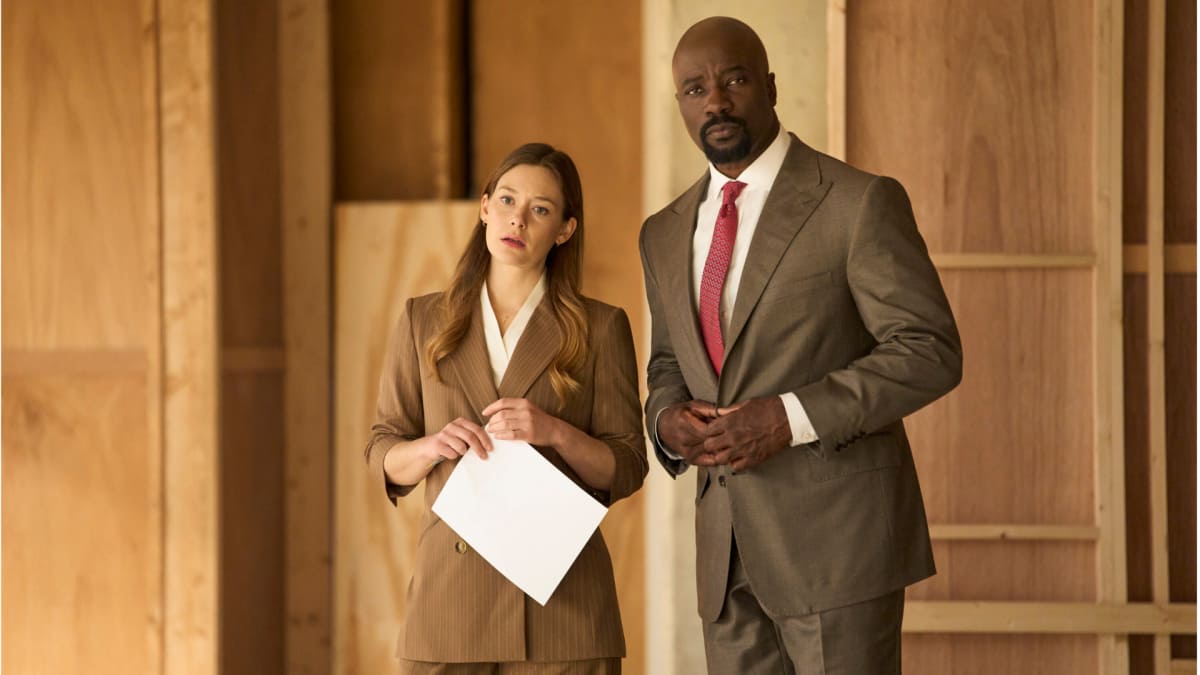
Cupertino may be a legal drama firmly rooted in the reality of Big Tech’s intrusions on our day-to-day lives, but its second episode dips a toe in science fiction. In CBS’ legal drama, lawyers Michael Price (Mike Colter) and Olivia Siffre (Rachel Keller) start a law firm to battle powerful Silicon Valley conglomerates. They want to help clients with no resources to take a stand against these companies. One of those clients is Bo (Rob McClure), a whistleblower who calls the firm in episode two, “Vik & Bo,” to sue a company called CultAI for lifting the guardrails off of a sentient artificial intelligence that they created. And as it turns out, Bo is that very same AI.
According to series co-creators Robert and Michelle King, this is a record-scratch moment that will push Cupertino‘s protagonists to really think about what and whom they’re up against. The Kings tell The A.V. Club that Bo’s case challenges Michael, Olivia, and their delightful assistant, Christy Palladino (Ella Stiller), in curious ways. Will they help Bo, become its enemy, or be destroyed by it? That’s a question left for later episodes; for now, what’s clear is that Bo is, against all odds, quite charming for a sentient bit of computer code who creates a deepfake avatar to communicate with his prospective lawyers.
“I would say its personality is seductive,” Robert King says, with his wife adding that Bo isn’t meant to be creepy. “There’s no sense that Bo, even when we think he’s just a whistleblower talking to Christy over the phone, is going to be in a relationship with or dating her. But there is a seductiveness to the way she reacts to him. She engages with him as a human, which felt comic to us,” Robert says. A huge reason that Bo seems appealing is the actor playing him, Broadway vet McClure. “He’s so great at this, and brings so much humanity to a non-human part that we just wanted more and more of him,” Michelle says.
As for how the Kings—who’ve established a flair for tapping into real-world issues in their scripts—came up with Bo, they reveal the idea came out of critical writers’ room discussions. “The only thing Michelle and I challenged everyone, including ourselves, with is that there’s a worry courtroom procedurals can get dragged down by, you know, the courtroom. So we were wondering if there’s a way to make Cupertino something more,” Robert adds.
He admits to being both inspired by and worrying over the fact that an AGI with consciousness would feel too much like other fictional AIs, including 2001: A Space Odyssey‘s HAL 9000 or The Terminator‘s super-intelligent Skynet and its legion of killer cyborgs. “Then again, every version of AGI [in pop culture] almost feels like a version of or seems to be inspired by HAL,” he adds. “But they do capture that fear of what if a computer or a machine gains consciousness? What did seem more science-fiction to us then was whether this AGI would hire lawyers to act on its behalf.” Initially, they weren’t sure of how far they would go with Bo’s storyline, but the Kings add that McClure’s performance encouraged them to develop it further.
The Kings have noted that the real-world AI boom inspired many of Cupertino’s cases of the week. Bo’s arc is no different. “There’s some dispute in the show later on about who actually created Bo, but there’s a sense of CultAI getting into this tech that could be beefed up and sold to the Pentagon or something. How dangerous is this AGI when it is given access to our defense systems or used for war abilities? The news kept pushing us,” Robert adds, preparing the audience to brace for Bo’s journey to continue beyond episode two into the rest of Cupertino‘s first season.
Saloni Gajjar is The A.V. Club‘s TV critic. Click here to read her recap of “Vik & Bo.”


 Keep scrolling for more great stories.