You’re never really alone anymore, not if your phone or car or any piece of smart technology is with you. This is a known fact: we are all trackable at all times via GPS, WiFi connections, cell towers, spyware, Bluetooth, cameras, and the apps we download, among other things. Privacy? We hardly know her. Being slapped in the face by a reminder of it in this week’s Cupertino is jarring anyway, because the show spells out the dangers of the surveillance state so effectively and poignantly. As has become the norm, it’s fascinating how the show—and episode writer Sejal Pachisia—turns something obvious into a relevant and fun topic for us to chew on.
Let’s tackle the first name in “Judith & Michael” because it’s a more surprising case for Price, Siffre, & Associates, since they haven’t done an all-out murder trial yet. They defend journalist Judith Song, accused of fatally shooting her primary source, Lionel, while reporting a story about the tech company Lionel worked for. In a whistleblowing video, Lionel claimed he worked at the data-mining company Churnata for six years before realizing corrupt executives were using the company’s tools to spread misinformation and interfere in elections. Lionel’s death was initially ruled a suicide, until Michael convinced the court that he was murdered as part of a cover-up—only for Judith to later be arrested for the crime as some sort of payback.
The evidence for Judith’s arrest, as per the ADA, is the footage of her a) arriving at but not leaving Lionel’s apartment building, and b) entering a gun store prior to the murder. For Michael and Olivia, an already alarming situation becomes worse because all this time, these security videos were allegedly missing. How did they mysteriously reappear, and what if they were doctored to frame Judith? AI is more than capable of creating convincing deepfakes after all. But no, it’s not that simple. Michael caught on to a symbol in the videos that points to a data broker recently purchased by Churnata: Booker East.
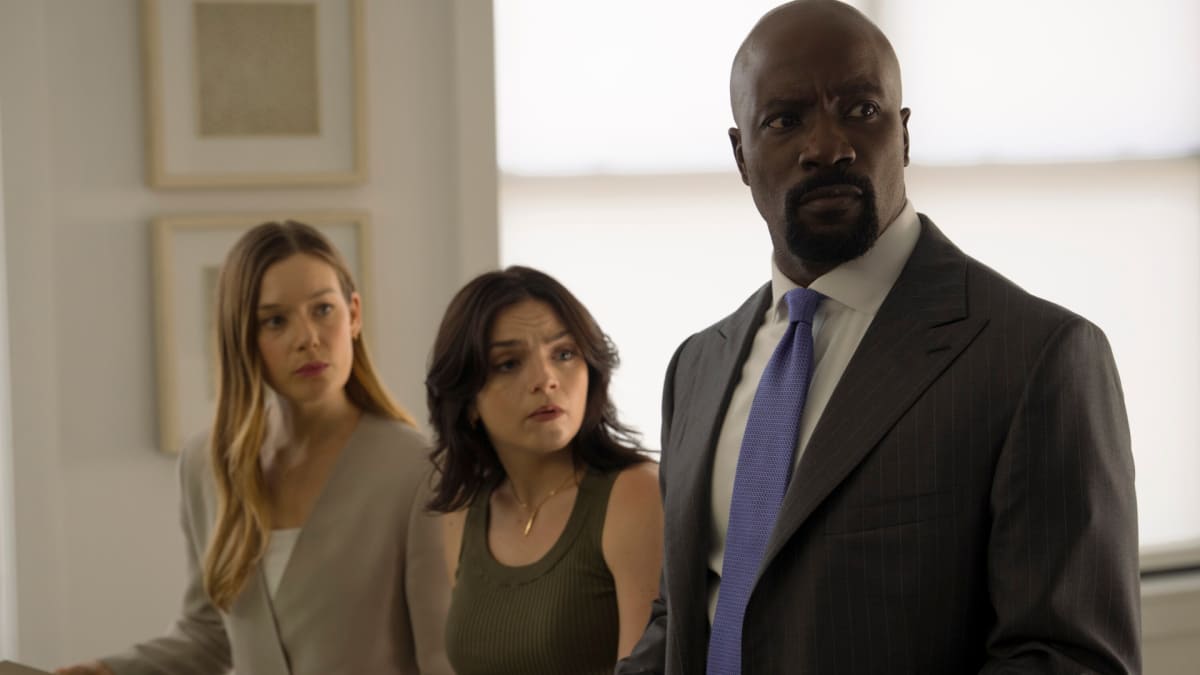
Booker East, as it turns out, collects data from computers, cameras, you name it, and sells it to the highest bidder. Isn’t that so reassuring? To figure out how exactly they work, the lawyers invite one of the Booker East reps to their office. The rep goes on to give a scary spiel about how every living human is nothing more than a data point. The more we move through the world, the more we reveal about ourselves to Big Tech companies, which quickly figure out how to monetize our needs, wants, and desires. This is only the start of the squirm-inducing elements of “Judith & Michael.” It gets worse from here.
To paint the clearest (read: eeriest) picture of their business model, the rep gives Michael, Olivia, and Natalia an example of how Booker East was recently hired by an airline, for which they devised a way to charge bereaved travelers higher prices. This involved cross-referencing customer records with the user logs of grief-support websites, tracking their church attendance, and scouring a vast array of personal information to determine which of these customers had loved ones who died in a different city. Booker East’s client could then jack up the cost of these customers’ flights on the presumption that air travel was inevitably in their future. Perhaps it’s creepy because of the constant smile plastered on the actor’s face as she breaks down the Booker East process, or maybe it’s the mere realization that this sort of thing could be happening to anyone at any moment, but it’s horrifying to listen to.
Cupertino confidently and precisely delivers an overload of information about how the surveillance state functions, going further into how Booker East has access to 80,000 street cameras nationwide—along with Ring and vehicle cameras—that monitor biometric data. Naturally, the company’s rep boasts about this data feeding predictive analytics on who might commit crimes, then selling it to law enforcement and cops. This is, of course, a frighteningly real problem due to a lack of judicial oversight—cops can bypass that system, and various states are still probing the issue or taking action on it. As widespread as this is, it often feels like not enough of us are considering it in our day-to-day lives. It’s startling stuff, but it’s also refreshing to watch Cupertino take it so seriously and discuss it so frankly.
The episode dives further by introducing yet another data broker, JPZ, which works with an even “lesser interpretation of the law” than Booker East. Michael, Olivia, and Natalia still hire JPZ because they want to find out how Judith’s footage suddenly became accessible, and whether it was manufactured—which, as it turns out, it was. Judith went to the gun store for research two weeks before Lionel was killed. There’s also evidence of her leaving his building hours before his murder through the back door. Not to mention that Michael and Olivia discover Churnata put malware in Judith’s phone to spy on her at all times. They then use that same malware to establish Judith’s whereabouts at the time of Lionel’s death.
The trio may have freed Judith, but they’re all prisoners themselves, being spied on to an intense degree. This leads to the reveal that the AGI Bo, which Colt AI deleted from the lawyers’ computers, hasn’t gone anywhere. While communicating with Christy through old-school kids’ toys (and even a cash register at one point), Bo reveals that just before deletion, he planted his source code in the phone of one of Colt AI’s human board members. Not only does Bo still exist, but it’s been keeping tabs on Michael, Olivia, and Christy. It realizes that they’re being tracked and that Michael is in some sort of danger. And Bo’s not wrong.
Two members of the state bar arrive at the Price, Siffre, & Associates office to investigate claims that Michael used Bo’s Bitcoin payment to gamble. That’s when Michael admits to his colleagues that, yes, he plays online poker a lot to relieve stress. Of course, he’d never gamble with the money clients gave to the firm. Naturally, the tech companies Michael has been going up against take revenge, as shown when JPZ finds a video of the state bar reps colluding to take Michael down. It’s another win for the good guys, but the takeaway is that this is just the tip of the iceberg. It’s a good thing—or is it?—that Bo is back to guide them through it, huh?
Stray observations:
- •To properly talk to Bo, Christy ropes Vik in to create an air-gapped computer and a Faraday cage so no one can trace them or discover they’re communicating with Bo. So Vik wraps a large gerbil cage and an umbrella in a ton of aluminum foil to create a mini hideout inside Christy’s bedroom where the computer—not connected to WiFi—can live. And for now, they don’t tell Michael, Olivia, or Natalia about it.
- •Bo suggests that, to avoid being tracked, the lawyers should all do the following: use only cash, cover their computer cameras, delete browser history, and create fake events in their calendars, among other paranoid but understandable steps.
- •Suspiciously enough, Bo also tells Christy it wants to retain the firm as its lawyer, but not to ensure Bo’s guardrails anymore. “We’re way past that,” Bo says. Let’s not forget that Colt AI’s on-the-run engineer, Kokie, told the lawyers Bo shouldn’t be trusted even if it claims to care for them.
- •On the plus side, Natalia throws in some furniture for the firm’s bare-bones office and claims that construction on actual walls will begin soon. Hopefully, by the end of season one, they’ll have a functioning workspace that goes beyond a fancy reception area.
Saloni Gajjar is The A.V. Club‘s TV critic.
Click here to read the previous recap.


 Keep scrolling for more great stories.