Even though Def Comedy Jam is responsible for launching the careers of some of the biggest names in comedy, it hardly ever gets the respect it deserves. It’s a common link among people like Dave Chappelle, Martin Lawrence, Bernie Mac, and Kevin Hart, yet the comedy world doesn’t give it the same adoration as star factories like Saturday Night Live or even MadTV. Instead Def Comedy Jam faced criticism for its portrayals of black people and dirty jokes. In celebrating the legacy of Def Comedy Jam, it would’ve been easy to ignore the show’s negative aspects and focus entirely on the subsequent success of the show’s top performers, instead Def Comedy Jam 25 demands respect by presenting a detailed history of its contributions to the comedy world.
If you’re looking for a traditional stand-up special, Def Comedy Jam 25 isn’t it. While Martin Lawrence, Katt Williams, and more take the stage, the overall sentiment is one of nostalgia and adoration. Tracy Morgan sets the mood early on when he thanks the crowd for supporting him in the wake of his bus accident and subsequent recovery. He moves Martin Lawrence to tears when he thanks him for taking a shot on him years ago. Sentimental speeches like this make up the bulk of Def Comedy Jam 25, but it works. The proceedings feel intimate, as though viewers are being given access to something rare and truly black and that’s because they are: The special is an invitation to the cookout. Def Comedy Jam 25 feels like watching your aunts and uncles share old family secrets and inside jokes. As the show remembers greats like Bernie Mac with touching tributes, you’re more likely to cry from sincerity, rather than laughing.
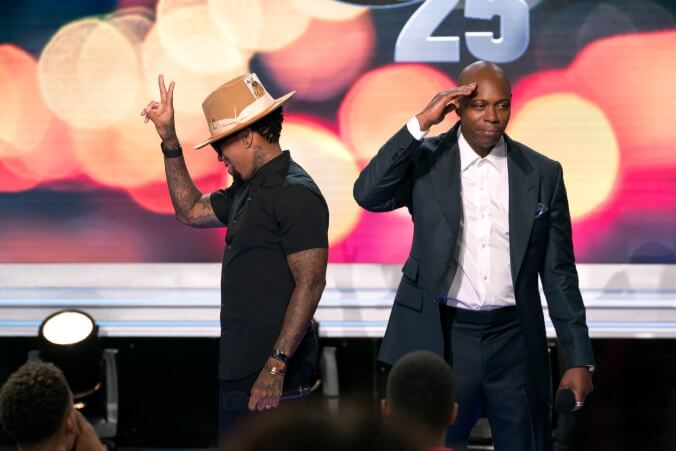
The camaraderie on display is responsible for some of the special’s best moments. When D.L. Hughley and Dave Chappelle come out to do some jokes on freedom of speech and our current political climate, Chappelle launches into an improvised bit that makes the entire event worth watching. While it’s disappointing that people like Chris Rock and Kevin Hart only participated via video, this gives up-and-coming talent a moment to shine. Tiffany Haddish is the perfect example of this. Even though she’s been well-known within black comedy circles for years, she’s has only recently been launched to fame thanks to her role in Girls Trip.
Haddish’s set feels like a breath of fresh air in the midst of nostalgia and greatest hits. Her involvement proves the special’s overall thesis that Def Comedy Jam was always in touch with the latest and greatest in comedy. That Def Comedy Jam had faith in a young Haddish speaks to the show’s skill at finding talented new comedians. Following her set, Haddish interviews Melanie Comarcho, Sheryl Underwood, and Adele Givens—black women who helped create Def Comedy Jam, but are hardly given the recognition they deserve by the media industry at large.
During its run, Def Comedy Jam was often criticized for its portrayal of black women, but the generational influence between the women onstage highlights how that criticism was misguided. The women who took on the Def Jam stage didn’t play into stereotypes of overly sexual or angry black women; they saw it as the one opportunity they had to talk about things that were traditionally taboo. As Haddish says, Def Comedy Jam was an opportunity to “say what she wanted.” At a time when black comics couldn’t get on the late-night circuit to launch them to fame, Def Comedy Jam opened doors.
Def Comedy Jam 25 takes a few moments throughout the special to dive into this history. Overall, it feels as though it has more girth than the traditional filmed celebratory proceedings. Def Comedy Jam refused to play within the rules of respectability politics and, rather than shy away from those criticisms, it proudly owns them. Backlash movements led by Bill Cosby and others who saw the show as detrimental are addressed. While some of those criticisms are legitimate, it’s clear that the good outweighed the bad when the careers that came from Def Comedy Jam are considered.
At the end of the special, Chappelle, Hughley, Lawrence, Steve Harvey, Cedric The Entertainer, and more create a massive presence onstage. “Def Comedy Jam made a bunch of black people millionaires” says Chappelle. This is the legacy that Def Comedy Jam 25 celebrates, and it’s hard to argue with that legacy when the results are on full display. Through the good and the bad, Def Comedy Jam 25 makes it clear that Def Comedy Jam is an institution that deserves respect.


 Keep scrolling for more great stories.