J.R.R. Tolkien filled the Lord Of The Rings trilogy with trios: Aragorn, Gimli, and Legolas; Merry, Pippin, and Treebeard; Sam, Frodo, and Sméagol. Rings Of Power has its fair share too: Poppy, Nori, and Gandalf; the Cultists. Once you start looking, Middle-earth is lousy with threesomes. We’ve seen positive depictions before, but this week’s installments explore how awkward and potentially dangerous a third wheel can be. Appropriately, the “secret” to Sauron’s One Ring is hidden in the three Elven Rings worn by Galadriel, Gil-galad, and Círdan, and the Lord Of The Rings is wedging himself into Celeborn and Galadriel’s romance to learn what that secret is. In these two episodes, Rings Of Power explores the dangers of interlopers in another ring-based relationship: Marriage.
Opposing these trios is Sauron, a character defined by the number one. It’s apparent in his philosophy, and he’s not coy about it. His domination addiction drives his plans for Middle-earth; watching others submit to him is pure bliss, he explains. That’s why he’s annoyed with Marnûkh, who, even while strapped to the rack, shows his connections to others. Sauron’s only friends are Orcs, whom he dominated by killing their former leader, the Orc abolitionist Adar. Unlike Sauron, Marnûkh believes in something and has connections to others, but Sauron can use those against him. Love is everyone’s kryptonite, and while Marnûkh thinks he has nothing to lose, Sauron, who strolls around him like a Bond villain with a laser pointed at the Orc’s heart, fires away. “You have five children, or should I say, ‘had,'” he says, and, in a first for the entire Tolkien Industrial Complex, Sauron describes Marnûkh’s youngest as having “kind eyes.”
The show deserves credit for expanding the depiction of Orcs. Much has been written about the racial implications of the creatures, often depicted as irredeemable invading hordes with vaguely Asian features. For his movie series, Peter Jackson continued the tradition, treating Orcs as nothing more than soulless goblins. It didn’t help that Orcs were the only jobs available to actors of color in his films. Sméagol could be redeemed, but Orcs could not. The Rings Of Power challenges this notion with Marnûkh, the Orc with something to lose.
Love is Sauron’s trump card, and his underlings are happy to play it. Thrain, who is working with the Nazgnagôl, wins the throne by resurrecting the memory of his dalliance with Disa, and he’ll lean on Durin and Disa’s love for their children to pry more information from them. With her kids’ safety on the line, Disa moves mountains to lead Lady Freyja the Fair (Emily Lloyd-Saini) right to Durin’s cell. Having connections to the environment also has benefits—though, of course, Durin and Disa have to blurt out the Seven Rings’ location within earshot of Freyja. C’mon, guys. At least we can hopefully put Disa’s relationship with Thrain behind us.
But with one love triangle dulled, Sauron sharpens his deadliest one for episode six’s central plot: Celeborn, Galadriel, and Sauron’s thorny ménage à trois. With the Orcs hot on their tail, Celeborn and Galadriel take refuge in the trees of Eryn Galen, but it’s not the safehouse they need. Celeborn jumped out of the frying pan and into the fire. He escapes dragon-fire because a horse kicked him into a ditch of water and spends centuries befriending Orcs and discussing trees and stars with the imprisoned Elven-smiths in Gundabad. When his wife finally rescues him, he gets a few hours with her before giving himself over to Sauron. This guy cannot catch a break. Even worse, Galadriel and Sauron notice the same thing about her place in all this; instead of searching for Celeborn, she was always too busy hunting Sauron. Why is Galadriel always choosing Sauron over him? A life of suffering gives Theo the answer.
Once Sauron steals Celeborn, Galadriel runs into Theo, awkwardly swimming in his Black Rider gear and having buyer’s remorse about a certain piece of jewelry. Things haven’t been going well for the Southlander. Have they ever? After watching Browyn die and Arondir leave, Theo was left wide open for the Dark Lord to put a ring on it. But when he asks Sauron to uphold his end of the bargain, the Lord of Gifts returns, “Be not a fool, my servant.” Now suffering from Ring sickness, Theo finds a powerful, forgiving ally in Galadriel who leads him to the woods of Lórien, where Celeborn and Galadriel hoped to build a house. She removes the Ring for him, and the withdrawals kick in. Through his pain and thanks to Galadriel’s healing song, he offers a clear read on her obsession with Sauron: “It’s easier to chase the darkness than face what you’ve lost.”
Back in Barad-dûr, Sauron straps Celeborn to Celebrimbor’s printing press and slowly crushes him until he shares what he knows. As much as Sauron wants to torment Celeborn, the Elf turns it right around on him, reminding his captor that, if Galadriel truly wanted to be with Sauron, she’d be with Sauron. So Sauron does what he does best and deceives Celeborn by disguising himself as Galadriel and letting the Elf talk. The secret was Finrod’s dagger, the one from Valinor, created by Fëanor, which Galadriel smelted for the three Elven Rings. But Sauron has Valinor metals, too: Fëanor’s hammer, which can only be destroyed in the fires of a big volcanic triangle outside Sauron’s window.
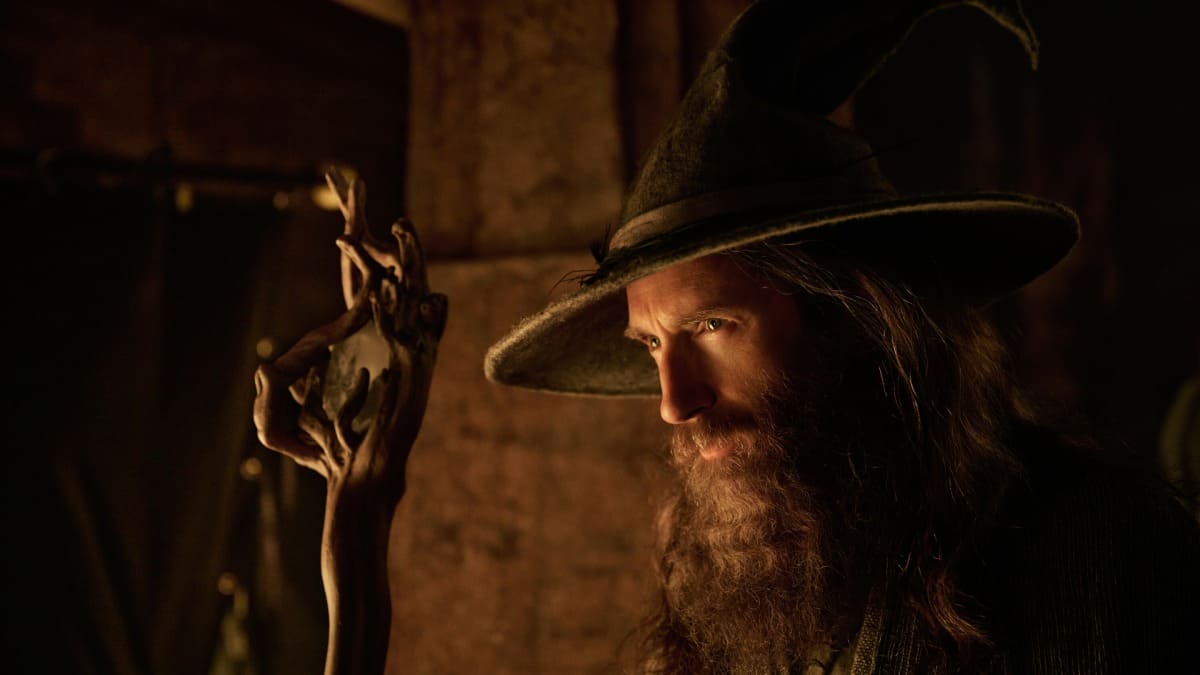
There are two other final trios at work in these two episodes. In Rhûn, Gandalf confronts Pallando, hoping to free him from the Nazgnagôl Khamûl’s clutches, and finds himself in a Wizard force-blast battle, like in Jackson’s Fellowship Of The Ring. To Gandalf’s surprise, the Secret Fire sent a different message with the Blue Wizard: He’s not meant to save Middle-earth but destroy it. Meanwhile, on the B-plot island of Númenor, Elrond and Gil-galad sail to meet Pharazôn, hoping to convince him to fight against Sauron, which requires uniting Númenor under a single banner. To do that, Pharazôn has a Shelbyvillian proposal: Marry his cousin, Míriel. This puts one of the season’s unactivated romances back on the board because Elendil has a wedding to stop and a love triangle to destroy.
The bonds between characters have always been what connected me to Tolkien. I don’t think I ever would’ve gotten far without Sam and Frodo, so it’s a relief to see The Rings Of Power move past breathless plotting for two episodes about character. After all, the Rings aren’t only used to destroy the world. They bind people to each other, whether their jewelry is magical or not.
Stray observations:
- • Eryn Galen is better known these days as Mirkwood, Legolas’ hometown. I wonder what the wood-Elves will make of Arondir’s death.
- • This show can pull a rug. When Galadriel arrived in Barad-dûr to rescue Celeborn, I was certain Celeborn was Sauron in disguise. He’s a tricksy one, stealing a kiss from Galadriel’s husband.
- • Pharazon’s eating was giving major Denethor vibes. I don’t remember loving Pharazon this much in previous seasons, but what can I say, I love the ham Trystan Gravelle is serving up.
- • As far as the scene between Elrond and Elros went, it was not the most dynamic of one-actor-playing-twins scenes. I love Robert Aramayo’s soft touch on Elrond but didn’t get much of a sense of Elros. Though, I appreciated how Númenorans reacted to him and his skin as hairless as stone.
- • I made light of Gandalf’s hat last week, but I’ll be damned if Daniel Weyman doesn’t cut a great silhouette in his Gandalf gear.
- • Loved seeing Charles Edwards back as the voice in Sauron’s ear, and when the show gets a little Shakespearean with its staging.
- • As much as I didn’t like the slapdash setup for Durin’s imprisonment in the previous four episodes, I can’t be too mad that it led to several instances of Dwarves singing at mountains. The show’s depiction of the truly mythic feats, which are some of the most casually strange and difficult to visualize in Tolkien’s legendarium, has led to its most unique and indelible moments. (Apologies to the haters, but a Dwarf singing at a rock is exactly what I want to see Amazon spend a billion dollars on.)


 Keep scrolling for more great stories.