Imaginative action meets confounding plotting and shallow metaphors in Ray Gunn, filmmaker Brad Bird’s long-awaited return to animation. The Netflix-produced feature affords the Iron Giant, Incredibles, and Ratatouille director a mature approach to his CG-rendered humans—primarily, a hardboiled detective and a short-tempered femme fatale. However, the movie’s immaculately designed metropolis is populated by an alien supporting cast whose main function is to hold up a half-baked segregation parable. This starts out vestigial to the story, but becomes increasingly awkward the more it enters the spotlight, resulting in clunky drama overtaking the eye-popping details.
Ray Gunn is a film of dazzling, mid-century retrofuture designs with distinctly modern concerns. For deftly combining an era of promise with technology gone awry, Bird undoubtedly deserves props; it looks like a dream. The art deco buildings are foregrounded by rent-a-jetpack stands in the vein of Citi Bikes, and intrusive, personalized advertising by way of holograms featuring a world-famous pop-star. This is the controversial Venus Nova (Scarlett Johansson), who gradually gets involved with a central plot that kicks off when “discreet” private eye Raymond Gunn (Sam Rockwell) is hired to steal information from a former associate. This vaguely ties into forging documents for extra-terrestrials, referred to by Gunn as “illegals”—a fairly loaded and ugly term by the standards of immigration metaphors. Granted, Gunn is a morally gray protagonist, but whether or not one considers Ray Gunn strictly children’s fare, this particular notion goes unchallenged, as the forgery subplot soon subsides.
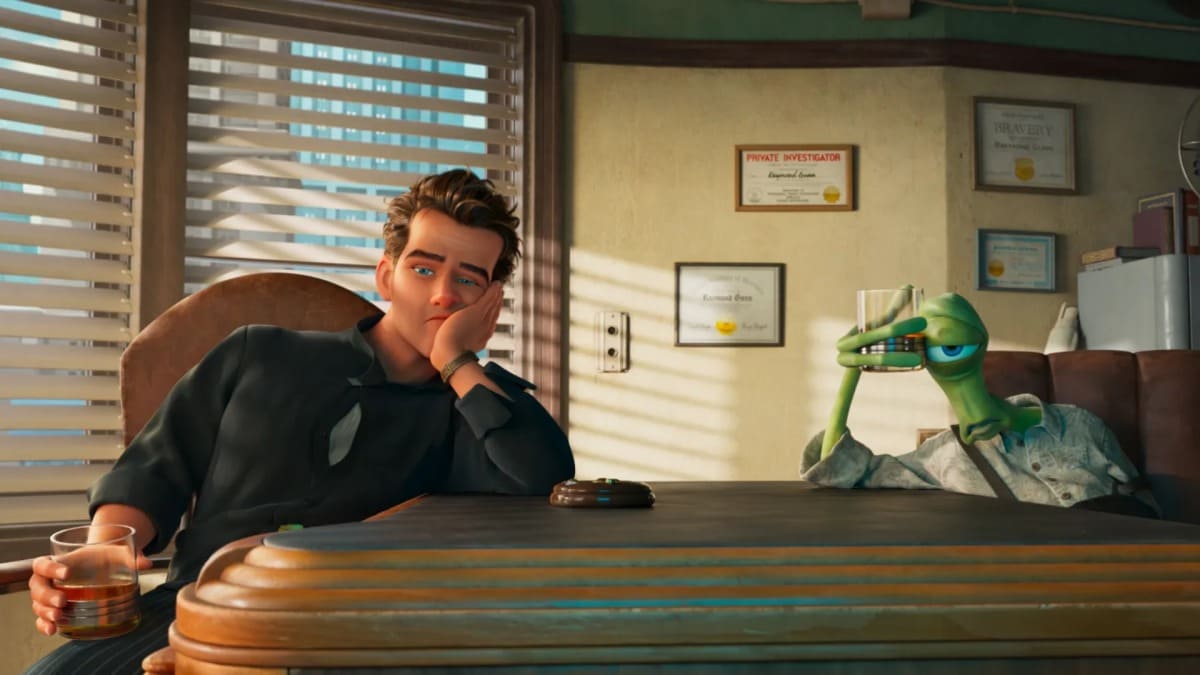
Still, Rockwell’s grizzled antihero is at the center of some snappy action, though he’s often the least fun and interesting part of it, lacking charisma, quips, or consistent characterization. Much more captivating is his one-eyed, green-skinned alien associate Eyera (Tom Waits), a down-on-his-luck assistant who does much of the sleuthing with a hilarious “Eh, it’s a living” disposition and a desire to make ethical improvements in a skeevy line of work. Eyera, a biomechanical being who handily snaps photographs with his cycloptic gaze, resembles a stretched-out Mike Wazowski, and is the first of several characters that feels like a half-remembered version of someone from Monsters Inc. This isn’t a bad thing. There are colors galore, and in the case of a middle-aged alien business magnate—whose appearance is a cross between Inc.’s Roz and Henry J. Waternoose—these designs gesture at larger ideas: The character tries desperately to fit human standards, tucking her extra appendages into a two-armed suit.
However, this detail of the movie’s worldbuilding, concerning how aliens assimilate into human society, is largely shoved aside until late into the two-hour runtime—a common trend. Meanwhile, Ray Gunn trades in platitudes about immigrant extra-terrestrials being an underclass and victims of apartheid, which is portrayed unevenly on screen. Sometimes, the aliens aren’t given medical treatment on the basis of their appearance. Other times, they’re just fully-integrated members of society, no questions asked. That their oppression is carried out by humans at large, including numerous Black supporting characters, makes for some jarring optics at best, given the movie’s Jim Crow-like “no aliens allowed” signage.
This is the strange environment that frames the film’s plot points, which arise gradually over several degrees of connection, starting with Nova’s ambitious husband Arnold Dom (Bobby Cannavale) hiring Gunn to keep tabs on the starlet’s tumultuous private life so they know what to keep out of the tabloids. This dovetails into malformed revelations (which is to say, references that eventually yield verbose payoffs) about the singer’s use of human stand-ins and digital copies to lighten her workload, her predatory record executives, her secretive personal life, her entanglements with an alien mob, and some genuinely intriguing notions of maintaining artistic authenticity in a world of corporate oversight.
That last bit is Bird’s most recent update on a pet theme: For decades, his movies have echoed the struggle for artistic honesty amid systems of control. Initially, Bird executes this with aplomb in Ray Gunn through a complex character trying her best to exist honestly in the limelight. Unfortunately, far less authentic is Bird’s approach to xenophobia, which lacks self-awareness throughout its borderline insulting conceit: depicting immigrant foreigners as insect-like creepy crawlies who love to sneak around, not unlike the language and propaganda frequently deployed to dehumanize them. This leaves the movie’s worldbuilding on par with the flimsily constructed Zootopia, where the underclass are quite literally predators. (If you follow Bird’s metaphor all the way, Gunn ends up donning the alien version of Blackface, but that’s neither here nor there).
If you can set aside these thinly-veiled depictions of modern U.S. social mores, the action is at least propulsive. Elevators rising and dropping several hundred stories yield whizzbang set pieces, while handy sci-fi technology like teleportation guns give way to some genuinely entertaining, child-friendly body horror. The protagonists also find themselves in several chases involving flying cars. It’s all pretty cool to look at, and Michael Giacchino makes it fun to listen to with his jazzy compositions.
However, these delights have a low ceiling, since the opaque plot never hints at why any of this really matters. Someone is carrying out some nefarious scheme for some reason, and rather than unspooling its nature gradually, Ray Gunn waits and waits before dropping its information all at once, in the form of plot turns that aren’t really twists, since they only reinforce things which have already been strongly and overtly established. One surprise, for instance, rests on not recognizing a minor character’s world-famous voice actor. Another, concerning Nova’s double life, depends on Gunn having no detective skills or intuition whatsoever.
All this would be far more tolerable if the title character had more going for him than mere P.I. pastiche. Rockwell’s naturalistic performance style doesn’t quite suit this expressive mode of animation. Voice acting is a different beast, and many traditional screen actors just don’t have the right tools. Rockwell, for instance, mumbles some of his dialogue, though even when he’s clear, he has little of interest to say. Gunn seldom has an identity beyond his initial concerns of making money in a line of work that demands moral introspection. His character arc is more of a character switch, and while his dynamic with Nova eventually proves enticing—Ray Gunn is one of the rare American animated films to feature genuine romantic tension—his allure and charisma pale in comparison to that of the quick-witted Eyera, who’s both a consistently entertaining presence and a much more sympathetic character.
There’s much to like in Ray Gunn, especially in how it looks. Each movement feels purposeful and momentous, as is Bird’s M.O. in nerve-wracking live-action films like Mission: Impossible—Ghost Protocol. Even in animation, his “camera” retains a sense of weight, presence, and purpose. However, even if Gunn’s trenchcoat is the right size and fit for a noir throwback, his film isn’t built to contain any of its themes, rendering Ray Gunn‘s central ideas as lip-service at best. That its narrative aim is so blinkered and askew prevents the film from soaring to Bird’s usual heights.
Director: Brad Bird
Writer: Brad Bird, Matthew Robbins
Starring: Sam Rockwell, Scarlett Johansson, Tom Waits, Matt Berry, Bobby Cannavale, Alan Tudyk, Kathryn Hunter
Release Date: December 4, 2026; December 18, 2026 (Netflix)


 Keep scrolling for more great stories.