The Rings Of Power returns for its third season with a renewed focus and a familiar aesthetic. Borrowing liberally from Peter Jackson’s bag of visual and audio tricks, the pseudo-prequel to Jackson’s Middle-earth movies looks and sounds more like the Lord Of The Rings people know as it turns its lidless eye toward the endgame. The show abandons the leisurely march of its first outing and Annatar’s elaborate trickery of its second for a streamlined season that cuts its cast list and cranks up the urgency to balance a metric ton of exposition. Season three is hasty. Sometimes to a fault.
The season premiere (Grade: B) opens with our trusty narrator Galadriel leading us through a time jump. Five years into The War Of The Elves And Sauron, Mordor’s forces have overtaken Middle-earth and inch closer to the borders of the Elven havens of Lindon and the newfound city of Rivendell. Under the mountain, infighting threatens to tear the Dwarven kingdom apart as Durin’s button-pushing brother and their father’s preferred heir, Thrain (Eddie Marsan), arrives to claim the throne and use the Seven Rings on Sauron’s behalf. In Rhûn and Númenor, the Kingdoms Of Men still haven’t picked a side, a pattern that will repeat in the Third Age. They all have less time than they think.
Sauron grounds the map-hopping series with an easy-to-track central plot. With Celebrimbor dead, Sauron lacks the Elven know-how to finish the One Ring, learning too late that massacring the Elven-smiths and burning their books on Elven-smithing wasn’t a smart move for an aspiring Ring Lord. Now Sauron must scour Middle-earth for remaining Elves with forging experience, and he assigns the job to the season’s lead Orc, Marnûkh (Adam Young), who immediately betrays his boss and turns the info over to the Dwarves and Elves. Meanwhile, Sauron focuses on choosing Mordor’s Next Top Nazgnagôl—his proto-Nazgûl who have yet to reach Wraith status—by pitting candidates from Rhûn and the Southlands in a single-sword battle royale to the death. It’s Sauron’s favorite game.
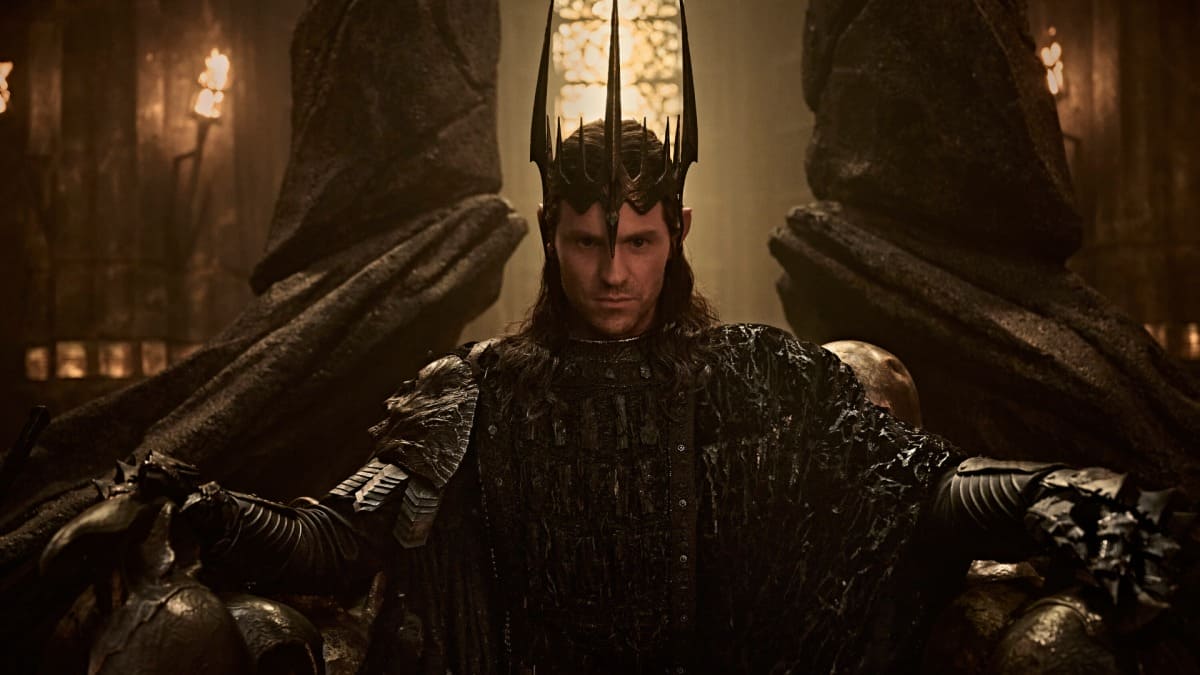
Charlie Vickers plays the unmasked Sauron with the remorseless evil we’ve been waiting for, watching with a wry smile as men and Orcs kill themselves for him. Sauron’s centrality keeps the show galloping forward but rushes things along too quickly. Rather than linger on Sauron’s conversations with Celebrimbor’s corpse, the show moves to Nazgnagôl interviews without building up its candidates. We already know the Nazgnagôl’s power from their run-in with Galadriel, and we’ll see more when they meet Durin; would it hurt to learn a thing about the warlord Khamûl (Zubin Varla) before sending him back to Rhûn? Everything in Mordor happens at once, and it all must keep moving.
Sauron’s clear aims are one of many streamlining efforts in the season’s first half. Co-creators J.D. Payne and Patrick McKay, who, along with Justin Doble, are the only credited writers on these episodes, leave our former audience surrogates, the Harfoots, behind. Eventually, Tom Bombadil follows. While Poppy, Nori, and Tom might reappear down the road, Eärien won’t. Episode two (Grade: C) returns to Númenor, where Pharazôn’s populist policies have forced Queen Míriel’s Faithful out of town. But the Faithful fight on.
As Míriel’s spy, Eärien conspires with her brother, Isildur, and carries the guilt of putting Pharazôn on the throne and sacrificing Faithful soldiers and her Faithful-hating aides to maintain her cover. It’s taking its toll, but as that poor Faithful prisoner says, her efforts have saved many. Eärien learns of plans for Pharazôn’s army to attack the Pelargir, the havens of the Faithful. Hoping to warn Elendil of incoming forces, she maneuvers to get Isildur time with the Palantir. She’s a better spy than a thief. Ultimately, she chooses defenestration over spending another second with Kemen.
Intercut with Numenor’s game of thrones is Theo, who took refuge in Pelargir after the Orcs slaughtered his mother and Arondir left with Galadriel. When Kemen pulls into town, the Faithful Haven becomes anything but, and Theo is reduced to the same Southlandian underclass he experienced under the Elves. He, too, chooses doom (or Doom) over time with Kemen and heads to Mordor to apply for Nazgnagôlship.
Sauron takes an immediate shine to him. Noticing the scar on Theo’s inner arm, Sauron puts his thumb on the scale and a sword through Theo’s competition. Nurturing and conniving, Sauron charms Theo with necromancy and a supposed history of his parentage. His father is Fäldred, one of the stewards of Mordor, “blessed with certain powers,” and who was murdered by Theo’s mother. Vickers looks like he won the lottery when he realizes who Theo is.
Episode two’s intrigue serves as not-so-subtle exposition that weighs the installment down. Númenor, in general, struggles for relevance as its big season still feels a year or so away. The third episode (Grade: C) has a similar problem. Like Sauron, Gandalf can finally be himself, but he’s stuck in Tom Bombadil’s house, hearing that he’s not ready to save his friends, so he should keep biding his time, as all immortal beings on the show do. But after spying on the Dark Wizard, sporting a fresh shade of Blue as he cedes control of Rhûn to the returning Khamûl, Gandalf is ready to go. In the season’s riskiest and most overtly Christian sequence, he speaks with the Secret Fire, who lays out his goal for the season: Save the Dark Wizard, who is actually the Blue Wizard Pellando, and retake Rhûn. Anyway, there’s no time to unpack Gandalf talking to Eru, Middle-earth’s God, because Gandalf has a hat to put on.
The show balances these new elements by reminding viewers what it is and where it’s heading. Rings Of Power has always learned from the movies. However, throughout the season, the show has looked and sounded more like Peter Jackson’s Lord Of The Rings, lifting the director’s costuming, slow-shutter photography, echoey soundscapes, and slapstick violence. Some of this is pure fan service. (Move over “Flash Enters the Speed Force”; Gandalf putting on his hat is a lock for this year’s “Most Cheer-worthy Moment.“) Other times, it does this to establish itself as a prequel to Jackson’s first Tolkien trilogy, like Revenge Of The Sith dovetailing into A New Hope’s design language. This is Lord Of The Rings, and as such, it shall be indistinguishable from the rest of TNT’s biweekly Fellowship Of The Ring/Two Towers/Return Of The King marathon and forthcoming WB productions set in this universe.
Familiarity has its benefits, though. In one of the season’s most compelling and dynamic story arcs, Marnûkh becomes Sméagol to Galadriel and Arondir’s Frodo and Sam as he escorts them to the Fortress Of Gundabad, where, rumor has it, the last Elven-smith is imprisoned. Episode three director Sanaa Hamri borrows heavily from The Two Towers and The Return Of The King, turning Arondir into a third wheel, recreating Sam and Frodo’s “po-ta-toes” scene with the bug eater and Galadriel’s all-too-quick dismissal and reacceptance of Arondir. Because we know these beats, the show can have some fun with them. In episode four (Grade: B-), Marnûkh’s double-turn is a welcome and unexpected surprise in all the rhyming poetry.
When The Rings Of Power strays from the familiar, it falters. Over the years, the show has struggled to depict and elaborate on Tolkien’s sexless storytelling. His books prize deep male friendships and intimacy of love found on the battlefield, and Rings Of Power has some of that with Durin and Elrond; it tends to gravitate toward hetero romances through remixes of Beren and Lúthien’s long-distance, mortal-immortal relationship—separated by distance or eternity. But the show invented a nice baseline for healthy, normal relationships among Dwarvish royalty through Disa and Durin, who have a sex life, just not one the show deals with explicitly. It simmers in Owain Arthur and Sophia Nomvete’s performance, but Thrain pulls it to the front burner, sort of, with a first-draft blackmail plot that threatens to reveal he and Disa had an affair. But the show doesn’t even have the confidence to spell out what it’s talking about, and forces two or three scenes of adults talking around the one-night stand euphemistically. Why bring this up at all if you’re going to be so chaste about it? At first, the show kind of gets away with it by having Durin react like an adult, given all that’s at stake. But after a few more misunderstandings, his anger gets the better of him, and he loses the throne and the Rings.
Durin and Disa aside, episode four gets to some adventuring the show can make a meal of and heads to Gundabad for a prison break. There, Celeborn (Jamie Bower Campbell) joins the fold with the season’s biggest surprise: He’s funny! Introduced a thousand years ago via a Crouching Tiger courtship with Galadriel, Celeborn initially resembles another aloof, ethereal child of Ilúvatar. He reappears in the most unlikely of places, the prisons of Gundabad, and Hamri introduces him with misdirection that thankfully skews the episode’s energy when it needs it most. “I’ve been down here so long, even I can barely recall,” Celeborn tells Arondir. “But there was a time folk called me Celeborn.” The horns swell as he steps into the light. “Who?” Arondir says, deflating the balloon.
Celeborn and Galadriel are denied their full reunion because, again, everything happens at once through the type of stacked climaxes the show uses way too often. Sauron arrives at Gundabad shortly after the Elves and chases the escapees to a balcony where Galadriel’s winged Über awaits. Before Arondir can escape, Theo reveals himself as a ring-bearing Nazgnagôl, and Sauron enters and instructs Theo to cut him down. Unlike Eärien, the show holds on Arondir’s death, giving Ismael Cruz Córdova a lengthy close-up in which to say goodbye. It wasn’t in vain. The whole arc gives Theo some much-needed juice and motivation to break bad. His story is easily one of the most intriguing thus far.
As the show marches toward its tragic conclusion, Rings Of Power continues its complicated, sprawling narrative at a brisk pace. These first four episodes breathlessly send viewers to Rhûn, across the sea to Númenor, into Khazad-dûm and the dungeons of Gundabad, through the cosmos, and up and down the coasts of Middle-earth. Anyone seeking a tour of Tolkien’s creations during the Second Age is getting their money’s worth. However, for a series that’s mostly about walking in the woods, it lacks the pit stops that allow us to enjoy the scenery. Rings Of Power has so much story to tell, but no longer has the Harfoots to notice what makes Middle-earth worth saving.
Stray observations:
- • The Shadow has returned. It’s me, Matt Schimkowitz, recapping Rings Of Power again. We’re batching these recaps to match Prime Video’s release schedule. We’ll be back next week with episodes five and six, followed by seven and eight on November 25.
- • On this release schedule: Bingeing this show does it no favors. Episodes two or three are especially rough and waylaid in Númenor, a better seasoning than a side dish, losing the urgency of the rest of the season. (Though it has some of the funniest and hammiest villains.) Episode three fares a bit better with the added benefit of some revelations, an oliphaunt, and an entertaining dynamic for Galadriel, Arondir, and Marnûkh. I also just really like Marnûkh, who eats bugs, but not in front of Galadriel.
- • Blue Wizard truthers, take a bow. As many predicted, the Dark Wizard is a Blue one.
- • Maybe this isn’t a risky prediction, but the powers Theo inherited might make him a frontrunner for Witch-king of Angmar.
- • It’s about time we got to see some bearded Dwarf women who were introduced with such ceremony, no less.
- • I didn’t always love the turns Disa and Durin took, but Eddie Marsan is a great get for the show. He makes for an obnoxious and contemptible villain.
- • Speaking of obnoxious and contemptible: Kemen.


 Keep scrolling for more great stories.