In the classic Ship Of Theseus thought experiment, we are meant to wonder whether or not a thing is still the thing if every piece of it has been replaced—a paradox famously presented by the regular Vision (who, of course, was just a magical recreation of the original Vision) to the sleek new White Vision (who had been reconstructed from the remains of the original Vision) near the end of WandaVision. VisionQuest seems to offer an answer to the conundrum: The Ship Of Theseus is no longer The Ship Of Theseus if it doesn’t retain The Ship Of Theseus’ memories. It’s just a Ship Of Theseus.
The new White Vision is the Vision, since he retains all of the physical pieces that made the Vision the Vision. But without having actually known Wanda or his friends in The Avengers, he’s also not the Vision. White Vision’s attempt to reconcile the differences between himself and the “real” synthezoid seems to be the guiding premise of VisionQuest, at least in its first two episodes, the second of which is actually titled “Theseus” and both reintroduces and reinterprets that aforementioned thought experiment from the perspective of a certain evil robot that lives in Vision’s attic.
But before we get to all of that, VisionQuest establishes the new status quo for White Vision—who, for the purposes of these recaps, we’re just going to start calling “Vision.” After the sitcom horrors that happened in Westview in WandaVision, Vision has moved to Edinburgh and is working in a pub that he (or, you know, the original he) and Wanda frequented when they were on the run post-Captain America: Civil War. He’s trying to revisit the life experiences the original Vision had in hopes of developing the kind of emotional connection to humans that made the original Vision a superhero.
When he’s not turning down dinner invitations from his cartoonish Irish bartender boss, he’s sitting motionless in the walk-in freezer and living in a virtual reality he built in his head. That reality takes the form of a wacky house that Vis shares with the other AI characters that Tony Stark developed in previous Marvel movies: D.U.M.-E and U from Iron Man (the silly garage robots), the original J.A.R.V.I.S. AI (played by James D’Arcy, who played the human Jarvis in Agent Carter and Avengers: Endgame), F.R.I.D.A.Y. (the AI voice that replaced J.A.R.V.I.S., played now by Orla Brady, replacing Kerry Condon when she was just a voice), and E.D.I.T.H. (the AI voice from the glasses that Stark gave to Peter Parker in Spider-Man: Far From Home, now played by Emily Hampshire instead of Dawn Michelle King).
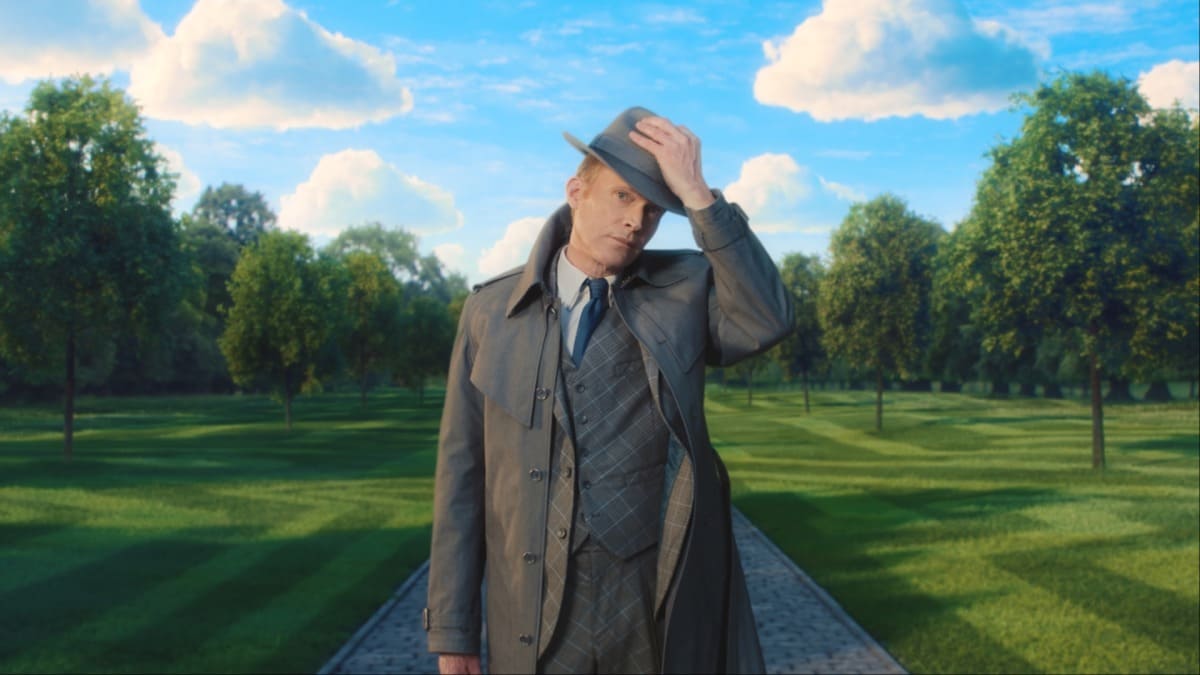
Vis has copied their AIs and stored them in his head to both keep them alive and to utilize their various areas of expertise (J.A.R.V.I.S. is uptight but helpful, E.D.I.T.H. is wacky and likes action, and F.R.I.D.A.Y. is… Irish?), but up in the house’s attic he has imprisoned the AI mind of Ultron (played by James Spader in both his robot form and the human guise that Vis insists on everyone using). The big AI house is a fun conceit, and it’s a nice nod to the “this is all a TV show” artificiality from WandaVision and (to a lesser extent) Agatha All Along, but it’s also not always as fun as it could be or should be when Ultron’s not onscreen. Other than Vision, maybe, Ultron is the only one of the AIs that actually feels like a character and not just character traits in a human-shaped body, which may have something to do with the fact that most of the people in this wacky house are best known as disembodied voices that say stuff like “Pepper Potts is calling for you, Mr. Stark.” And they aren’t especially fleshed out beyond that, other than literally.
Thankfully, VisionQuest is not a sitcom about robots living in a virtual house, because it’s not funny enough to justify that. This is definitely more of an action show, as evidenced by the fact that Vis’ boring human coworker is almost immediately murdered by a sniper when mysterious soldiers attack the bar in hopes of capturing him. The voices in Vis’ head convince him to run away, which he does, and then we meet the leader of the mercenaries: A guy called Paladin, played by Todd Stashwick, who also has a voice in his head who’s also not as funny as the show seems to think. This one is a human, as far as we know, and she’s played by the generally very funny Diane Morgan. She’s not doing anything wrong here, but the way she just reacts to things happening on a computer doesn’t feel all that different from what you normally get out of J.A.R.V.I.S. or F.R.I.D.A.Y. It just feels like someone could’ve said “this show needs more jokes” and brought in Diane Morgan without changing a single other thing about it.
Back in his head-house, Vis finds out that Ultron has been sending messages out into the world and that he tipped off Paladin to Vision’s location. There is apparently a gigantic bounty on Vis’ head, though we don’t know who placed it yet, and Ultron was hoping that sending Paladin after him would spur Vision into doing something other than just hiding and wasting his chance to have a life.
Meanwhile, Paladin does some research into this Vision guy he’s been hired to kill, and he finds out about the Westview incident (which had been covered up by the government) and the fact that Vision had two sons in the fake reality that Wanda created. With some simple Googling, apparently, Paladin discovers police interview footage of a young man named Thomas Shepherd who, after nearly drowning in a pool (see: Agatha All Along) believes that he now has memories of two different lives in his head. In one, he’s nobody particularly special. In the other, he’s Tommy Maximoff, the son of a witch and a robot. Also more easily than you’d think, Paladin finds and kidnaps Thomas and then broadcasts a digital signal that only Vision can detect in which he says he has Vision’s son.
The second episode introduces Thomas’ backstory, or at least the relevant bit, which is that the British police decided to send him to some kind of hospital/prison after he started freaking out about having two lives in his head. While on the bus to Hospital Prison, he meets and befriends a girl named Lisa who is able to get through to him in the middle of a breakdown. She’s being sent to Hospital Prison because she’s a notorious pickpocket, which makes no sense, but she and Thomas decide to escape after she sees him accidentally use his nascent superpowers—which, at this point, just involve his hands shaking so fast that he makes electricity or rattles doors off their hinges.
Let’s not bother pretending we don’t know what’s happening here: In the comics, Tommy Maximoff is also known as Speed, a Young Avenger with super-speed powers (taking after his uncle). He is… let’s say less consequential than his brother Billy, a.k.a. Wiccan, who is married to the leader of the Kree-Skrull Empire these days. Compare that to comic book Tommy, who sometimes gets mentioned. We’re obviously heading toward this version of Tommy (who prefers Thomas) further developing super-speed powers over the course of VisionQuest, much like how Billy expanded his magical talents during Agatha All Along.
Back to the kidnapping plot: Vis doesn’t want to accept that he has a son, believing that Billy and Tommy were erased from reality when Wanda’s spell ended (if she had known that wasn’t the case, Doctor Strange In The Multiverse Of Madness would’ve been a much shorter movie). After an initial encounter with Paladin back at the bar, Vis talks to Ultron about how he doesn’t know if he should care about this kid who might be kind of the son of the other Vision. That’s when Ultron presents his own take on The Ship Of Theseus: It’s not about the ship at all, it’s about Theseus himself—the Athenian king who killed the minotaur and saved the children of Athens. Ultron says he should stop worrying about whether he’s the same as the original Vision: “When a monster has your son, don’t be the ship. Be the goddamn king.” Good line, and Spader sells it like the pro he is.
Emboldened, Vision responds to Paladin’s threat and flies off to Hospital Prison, where Thomas has been taken prisoner. After casually strolling into the lobby, he drops his own good line: “My name’s Vision and I’m here for the trap.” The staff of Hospital Prison have been replaced by Paladin’s soldiers, and they all get turned into bloody mist by Vision’s head-laser. Vis quickly finds Thomas and walks into the real trap: A magnet room that overloads his processors and threatens to destroy his electronic mind. Paladin comes in with a shotgun that fires adamantium rounds (you know all about adamantium in the MCU if you saw Captain America: Brave New World, which you probably didn’t). This basically straight-up kills Vision, which, again, seems like it was pretty easy, but he and Thomas are able to get outside and lose Paladin’s soldiers. Vision, about to die, tells Thomas to leave without him and plays up the “I don’t have feelings, I’m a robot” thing even though nobody buys it.
In Vis’ head-house, the AIs are freaking out about the fact that they’ll all die if Vis dies, so Ultron suggests that one of them makes a heroic sacrifice to free up enough processing power to save the others. J.A.R.V.I.S. decides to delete himself, reminding the others (including Ultron and Vis) that “family is forever, and it’s worth the fight.” With Vis and the AIs saved, Thomas drags Vis into a car and they drive off. Vis groans that Thomas didn’t listen to his command to save himself, to which Ultron replies, “like father, like son.”
Stray observations
- • Hello True Believers, I’m Sam Barsanti and I’ll be carrying us all through the next few weeks of VisionQuest recaps. Disney+ is apparently releasing the first six two-at-a-time, so we’ll hopefully have some meaty stuff to discuss.
- • Since VisionQuest is the conclusion of a trilogy of MCU TV shows, here are my thoughts on the other two: I thought WandaVision was a lot of fun, even if the Dragon Ball Z fight that ended it all was a snooze. I wasn’t overly enamored with Agatha All Along from episode to episode, but I really liked the finale and the ultimate “Witches’ Road” reveal. I do hope Agatha and Billy show up here at some point.
- • As far as Marvel characters go, it would be generous to call Paladin a D-lister. Still, it’s nice that it’s a name from the comics, considering that every single other Marvel mercenary (Crossbones, Taskmaster, Bullseye, etc.) is either too famous to be included in something like this or has already appeared in the MCU.
- • It seems like a waste of James D’Arcy to kill him so early, especially since now we’re left with AIs who have been recast and AIs who don’t speak. He was the guy we knew from other things!
- • Every time Ultron dips into a monologue in which he makes sweeping generalizations about mankind, it might as well be Robert California insisting that “there is only sex” to Toby Flenderson. (This will likely come up again, but I love Robert California and season eight of The Office is good.)
- • Other than Ultron, I’m concerned that I’ll get sick of the other AI characters and how simplistic they are. That means Thomas, as the lone human character, is going to have to carry a lot of emotional weight. We’ll see if he’s up for it.
- • Before Vis goes to save Thomas, J.A.R.V.I.S. mentions that emotions can be dangerous, a fact that “he” knew better than the other AIs. The camera then holds on a painting of a figure on fire, the “he” in question, who Vis refers to as “the first of us.” Just for fun, let’s not spoil who this is referring to yet.
- • VisionQuest showrunner Terry Matalas explained a while back that there would be no generative AI use in the show. That’s great, because generative AI is evil and fascist, and using it for a show about AIs would’ve at least been a slightly less desperate and insulting idea than the lazy justification behind the AI opening credits of Marvel’s Secret Invasion. I, of course, have nothing to say about that, so let’s never bring it up again.
- • Seriously, though: Where are we putting Ship Of Theseus on an overplayed thought experiment tier list? Higher or lower than the Trolley Problem?
“No Strings” grade: C+
“Theseus” grade: B


 Keep scrolling for more great stories.